
For over two decades, Google shaped how businesses were discovered online. Search Engine Optimisation (SEO) revolved around keywords, backlinks, page rankings and technical tricks designed to please one dominant gatekeeper.
That era is ending.
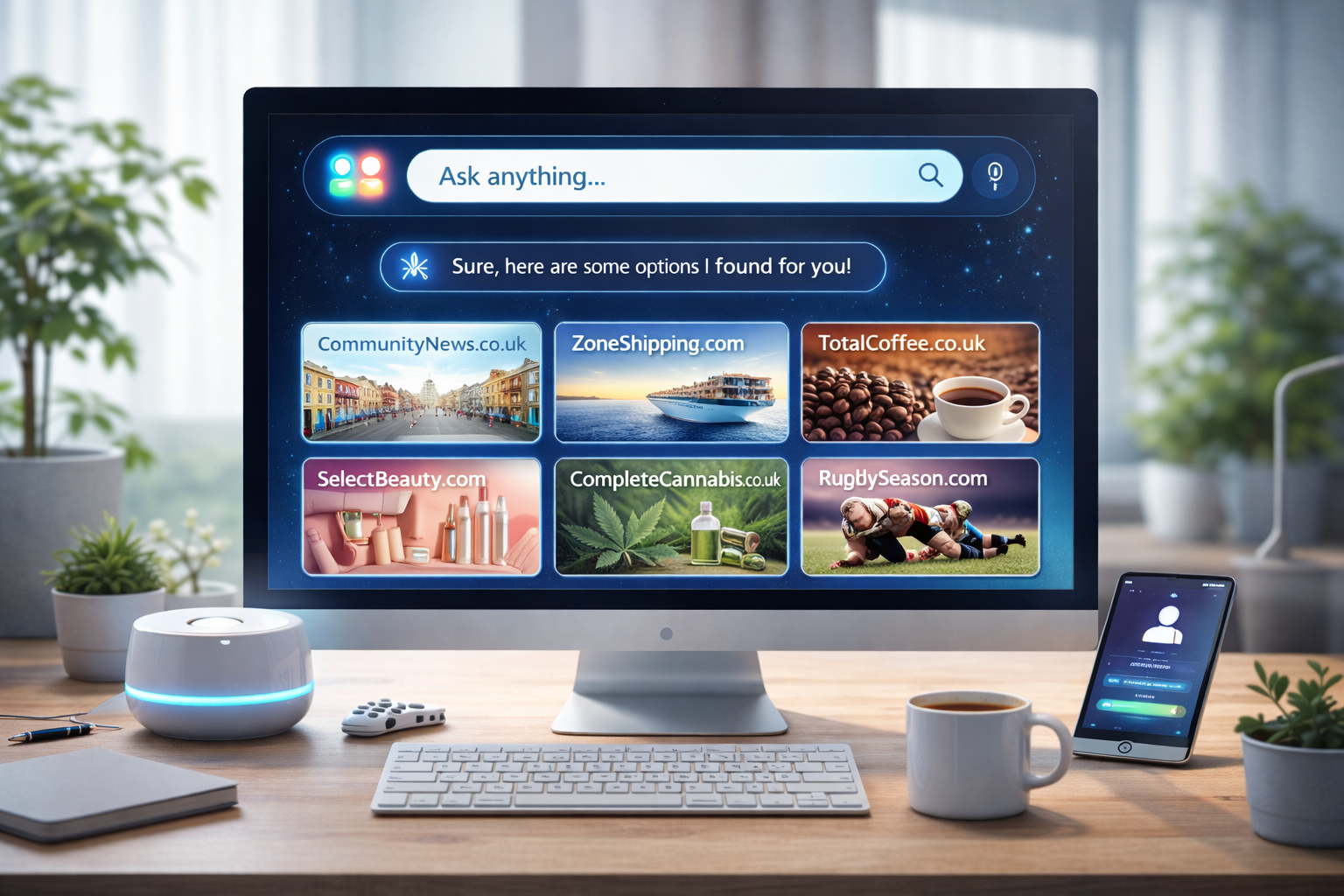
We are now entering a phase where AI-driven search, assistants, and recommendation engines – not traditional search result pages – are becoming the primary way people find businesses, products and services. And this shift radically changes the role of domain names (URLs).
In short: your domain name is no longer just an address – it’s a signal of meaning, trust and relevance.
From “Search Results” to “Answers”
AI search doesn’t work like Google used to.
Instead of presenting ten blue links, AI systems:
- Interpret intent
- Summarise knowledge
- Recommend entities (brands, services, organisations)
- Prefer clarity over cleverness
When an AI system is deciding which business to mention, which site to reference, or which brand to recommend, it looks for strong semantic signals.
Your domain name is one of the strongest of those signals.
Domains as Meaning, Not Metadata
In traditional SEO, a business called BlueRocket123.com could rank well with enough optimisation.
In AI search, that kind of abstraction works against you.
AI models favour:
- Clear language
- Literal meaning
- Human-readable relevance
Compare:
- WomensRugbyUnion.com
- RhubarbGin.co.uk
- GardeningDiary.co.uk
These domains instantly communicate what they are – to humans and machines.
AI doesn’t need to “figure them out”. It recognises them as authoritative, topical, and trustworthy by design.
Brand Recall Matters More Than Clicks
AI search reduces browsing. Users don’t scroll – they remember.
If an AI assistant recommends: “You might want to look at GardeningNews.co.uk”
That name sticks.
Memorable, descriptive domains:
- Are easier to recall
- Are easier to speak
- Are easier to trust
- Become shortcuts in the user’s mind
This is a return to brand clarity, not keyword stuffing.
Trust Signals in a Noisy AI World
As AI-generated content floods the internet, credibility becomes scarce.
Domain names act as a trust filter:
- Clean, focused domains feel intentional
- Generic or cluttered domains feel disposable
- Long or confusing URLs feel temporary
A strong domain name suggests:
- Longevity
- Serious intent
- Ownership of a niche
AI systems are trained on human trust patterns – and humans trust names that make sense.
AI Prefers Entities, Not Pages
One of the biggest changes happening quietly is that search is moving from:
“Which page ranks highest?” to: “Which entity is most relevant?”
An entity can be:
- A brand
- A category leader
- A recognised topic owner
Your domain name helps define whether your business is an entity – or just another webpage.
Owning a domain like:
- SelectBeauty.com
- WineAwards.co.uk
- SheringhamProperty.co.uk
positions you as the thing, not a blog about the thing.
Why This Matters for 2026 and Beyond
Businesses launching now are not competing with websites – they’re competing with:
- AI summaries
- Voice assistants
- Recommendation engines
- Embedded answers inside apps and platforms
In that environment:
- You won’t always get a click
- You won’t always get a ranking
- You will get referenced – or ignored
And when AI chooses who to reference, names matter.
The Quiet Advantage Smart Businesses Are Taking
Savvy founders are already:
- Securing strong, descriptive domains early
- Choosing clarity over trendiness
- Treating domain names as strategic assets, not technical necessities
Because once AI associates a concept with a name, it’s hard to displace.
And the conclusion…
In the Google era, SEO could compensate for weak naming.
In the AI era, your name is your SEO.
A great domain:
- Explains your business instantly
- Signals authority automatically
- Travels well across AI systems
- Ages far better than tactics or platforms
If search is becoming conversational, contextual and intelligent – then your domain name needs to be too.